Why Does Mechanical Pencil Lead Keep Breaking? (And How to Stop It)
Every mechanical pencil owner knows the sound: a tiny, bitter tick halfway through a word, followed by a shard of graphite under your nail as you dig the stub out. If your mechanical pencil lead keeps breaking, you're not unlucky and the pencil isn't random. Lead breakage is physics — leverage, mostly — and physics can be argued with. Here's why pencil lead keeps breaking, in rough order of how common each cause is, with a fix you can do in the next sixty seconds.
The six causes — and the fix for each
1. You're exposing too much lead
Every millimeter past the nose cone turns the lead into a diving board. Graphite is strong in compression — the direction your hand actually pushes — and weak in bending. A 0.5mm core sticking out more than 3 or 4mm has so little support that the normal force of ordinary writing multiplies at the base, right where the lead exits the collet. That's exactly where it snaps.
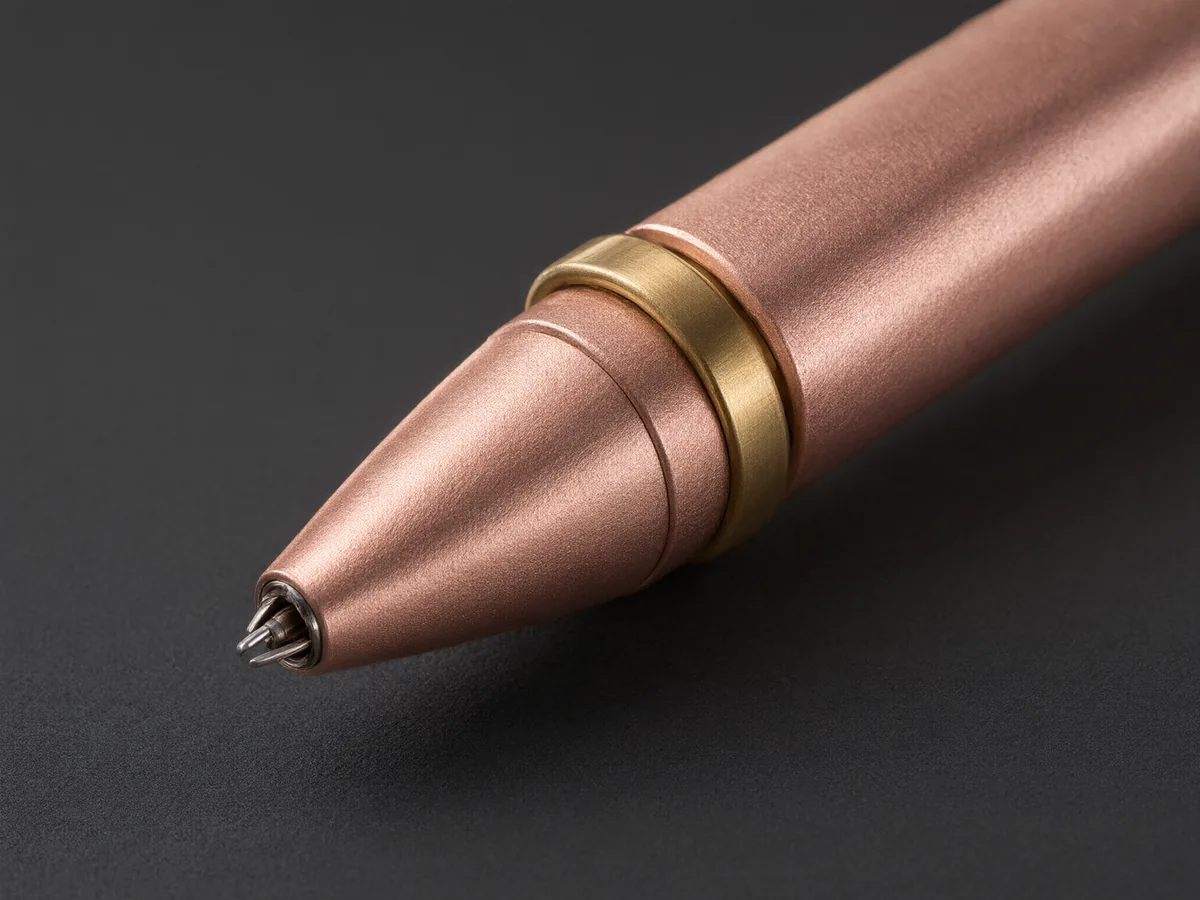
Fix: advance 1–2mm at a time — one click, not three — and break the tip on scrap paper before writing. If your pencil throws out a fixed 3mm per click and that's too long for your hand, you have a feed-control problem, not a lead problem. A pencil whose exposure you can set and stop — like the magnetic slide-ring design we sell — lets you dial in the length and never go past it.
2. Your angle is too steep and your pressure too heavy
Hold the pencil nearly vertical and you're stabbing at the page with the tip instead of gliding the side across it. The point catches on paper fibers, each stroke lands as a blow, and a tired hand squeezing in overtime doubles the force. Breakage in the middle of a word, on the downstroke, is the signature.
Fix: drop the pencil to about 50–60° from the paper so the side of the tip rides the surface. Add a cushioned grip or a rubber band around the barrel as a squeeze reminder, and switch to a grade that lays dark without pressure — a 2B asks far less of a heavy hand than an H ever will. Softer grade, lower angle, lighter grip: three changes, and the snapping mostly stops.
3. Fine lead is physically fragile — stop blaming yourself
A 0.3mm refill is a stunt; a 0.5mm is a compromise. No brand, grade, or trick makes thin graphite tough, because graphite is a sintered clay-and-carbon rod and its strength scales with cross-section — and there simply isn't much cross-section to work with. The single best way to prevent lead breakage in a fine pencil is to stop using a fine pencil for the wrong job.
Fix: move to 0.7mm for daily notes — a barely-different line, dramatically tougher — or 0.9mm if your body takes it. Keep the 0.5 for lettering and detail work where it earns its living. If you write all day and your 0.5 snaps daily, the honest diagnosis is that the tool doesn't match the task.
4. Cheap or damp refills
There's a reason you can buy six tubes for a dollar. Bargain leads are unevenly fired: micro-cracks, grit inclusions, rods that crumble when you load them. Humidity adds a slower kind of damage — a stick that soaked in a damp backpack loses strength in the clay binder and chalks instead of snapping clean. If the breaks come with powdery dust and irregular stubs, the culprit is in the tube.
Fix: switch to a known refill line and feel the difference within an afternoon. Store tubes dry, in their case, not loose in a pencil pouch or a jacket pocket on a job site. Retire any stick that looks chipped or feels gritty-soft.
5. Graphite dust in the collet
Inside the nose, three tiny collet jaws grip the lead. As sticks wear and pump in and out, graphite powder accumulates between jaws and core, and the grip goes slack. The lead spins and pistons under your hand instead of staying fixed — and snaps just past the jaws. Telltale signs: the line fades mid-word, the tip looks shiny and glazed, and you're advancing more often than you used to.
Fix: clean it out. Push a spare stick through the nose several times to dislodge the packing, or run the little wire cleaning needle that comes bundled with our pencil through the sleeve and twist. If your model's nose unscrews, open it and clear the feed path directly. Two minutes with a needle stops a lot of "mystery" breakage.
6. Drops have bent the lead inside the sleeve
Drop a pencil tip-first on a tile floor and the exposed core is now an L. A kinked stub pokes out of the cone at an angle and dies on the first stroke, and the jagged remnant often jams the sleeve so no fresh stick seats properly. Then every new lead breaks too, and you blame the new refill for the old fall.
Fix: prevention first — never park the lead extended when the pencil goes into a pocket. Most fine mechanicals can't retract the core fully, which is a real limitation of the format; a 2.0mm magnetic-slide pencil pulls the lead back inside the cone entirely. If a stick is already bent, advance it, snap the kinked bit off against scrap paper from the underside, and never force a jam — work the cleaning needle through from the nose instead.
Go thick: why 2.0mm almost never breaks
Here's the blunt option. A 2.0mm core has sixteen times the cross-sectional area of a 0.5mm, and in bending resistance it's roughly sixty times the fight — strength scales faster than diameter does. Breakage stops being a daily event because snapping one takes real effort: a mile of exposed lead and a deliberate lean.
The 2mm format also fixes the geometry. Instead of a needle sticking out of a tube, you cone-sharpen the graphite into a short, supported point — here's how to cone one — so there's never an unsupported cantilever to snap. And the same tip covers a fine point and a broad shading bevel, which is the whole argument in our lead holder vs mechanical pencil breakdown. It's not a form-filling tool; for that, a 0.7mm clicky still rules. But if you draw, draft, or mark, 2mm changes the question from "why does pencil lead keep breaking" to "how do I wear this thing down."
$13.49 in rose gold ($14.99 black). 6061-T6 aerospace aluminum at 17.2g; the magnetic slide ring adjusts lead exposure or retracts the core fully inside the cone. Ships with a lead sharpener, cleaning needle, and spare ring. 4.2★ from 3,145 Amazon ratings.
Quick self-check before you blame the pencil
- More than 2mm of lead showing? Feed one click less and break the tip on scrap.
- Writing vertical with a death grip? Lower the angle to 50–60° and switch to 2B so pressure stops being your tool.
- Using 0.3 or 0.5 for all-day notes? Move up to 0.7mm — the easiest way to prevent lead breakage in a fine pencil.
- Refills are unlabeled? Try a known tube before you buy a new pencil.
- Line fades mid-word and the tip looks glazed? That's collet sludge — run a cleaning needle through the nose.
- Pencil lives tip-out in a pocket? Retract it, or switch to a design that retracts fully.
- Everything above checks out and it still snaps? The format is the problem. Consider 2mm.
FAQ
Why does my mechanical pencil keep breaking fresh leads right after advancing?
Two usual culprits. Either you're over-advancing — three millimeters of exposed 0.5mm core has almost no support and snaps at the collet — or the jaws are loaded with graphite dust and slipping. Advance one click, break the tip on scrap, and run a cleaning needle through the nose. That combination fixes most "new lead dies instantly" cases.
Which lead grade breaks least: H, HB, or 2B?
H and 2H are hard but brittle and chip cleanly; HB is the safe default; 2B is softer and wears faster, but it lays down dark marks with almost no pressure. For a heavy-handed writer, 2B usually snaps less because it asks less of you. See what 2B actually means for the full grade picture.
Does humidity actually weaken pencil lead?
Fired graphite shrugs off short exposure, but leads that have sat in a damp bag can soak moisture into the clay binder and crumble instead of snapping clean. Store refills dry in their case, and retire any stick that feels chalky or powdery.
Can a 2mm lead still break?
Yes — leave ten millimeters sticking out and lean on it like a pressure test, and anything snaps. But you have to work at it. Cone-sharpened to a short point and retracted into the sleeve when stored, a 2mm core outlasts the pencil it lives in.