Lead Holder vs Mechanical Pencil: What's Actually Different?
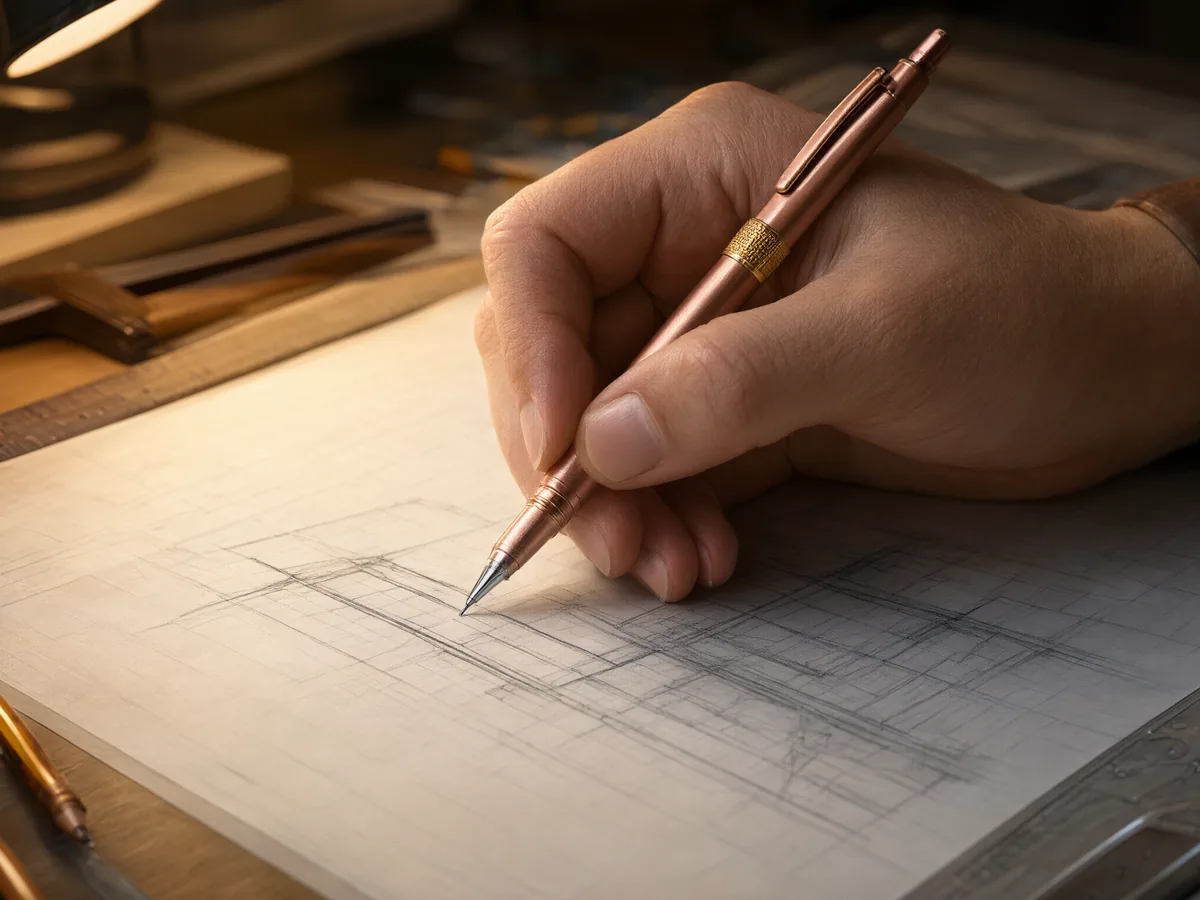
Walk into any architecture studio and you'll find two kinds of pencils fighting for space in the cup: fine 0.5mm mechanicals for writing, and chunky 2mm lead holders for drawing. They look like relatives, load like cousins, and behave like completely different tools. Here's what actually differs under the metal — and which one deserves room in your roll.
First, what even is a lead holder?
A lead holder (drafters sometimes still call it a clutch pencil) is a mechanical pencil built around a thick, 2mm graphite core instead of a thin 0.3–0.7mm one. That single change ripples through the whole design: the jaws that grip the lead are longer and gentler, the sleeve is sturdier, and the tip you draw with can be coned to an actual point — like a sharpened wood pencil — instead of a needle stub poking out of a tube.
The mechanism that advances the lead is where designs diverge. Classic holders use a knurled collar you twist, click-action holders borrow the button from an ordinary mechanical, and magnetic designs — like the ring-controlled pencil this site is built around — slide the jaws up and down with a magnet.
A short history you'll hear at every studio crit
The clutch pencil predates the mechanical pencil most people know. Early 20th-century drafters carried brass holders with knurled chucks that clutched a thick core — hence the name — and refined points with a knife and a strip of sandpaper. When technical drawing shifted to thin, uniform lines for reproduction, the fine-lead clickers took over drafting rooms, and the holder survived in two stubborn places: architecture studios and carpenter's pockets. It never needed to change much. The lead is the tool.
Which is why the one genuine modernization of the format — replacing the click and the coarse collar with a continuously adjustable magnetic slide, as in the pencil this site covers — is worth understanding before you buy your first holder. You'll feel the difference every time you change line weight.
Head to head: the five real differences
1. Breakage resistance — the big one
A 0.5mm lead snaps if you look at it sideways. It's not a quality flaw; thin graphite is simply brittle. A 2mm core has roughly eight times the cross-sectional area of a 0.5mm one, which is why job-site carpenters and drafting students who drop tools constantly live by lead holders. As one reviewer of our own put it, bluntly: with 2mm, it's "practically impossible to break."
2. Line variety from one tool
A fine mechanical gives you one line: whatever width the stub exposes. A 2mm holder gives you a family of lines. Cone the lead to a point and you get a crisp 0.5mm-ish line. Tip it sideways and you get a broad, soft wash for shading. Architects exploit this constantly — elevation line weights in one tool, no switching pencils mid-sheet.
3. Feedback and control
Thin leads deflect. You feel a faint spring before a 0.5mm tip touches paper; that squish is why fine mechanicals can feel "bouncy" at speed. A 2mm core is rigid — what your hand does, the line does, instantly. For technical linework and for anyone frustrated by that rubbery feel, it's a revelation.
4. Consumables and cost per semester
Here the mechanical pencil wins. 0.5mm refills are cheap, everywhere, and a single stick lasts a week of writing. 2mm leads cost more per piece (you're buying dense graphite rods), and a freshly coned point wears down faster than a hard 0.5. If your job is filling forms, buy the clicker.
5. Smudge and pressure handling
Broad, soft, 2mm shading smudges like charcoal if your palm crosses it — fine, hard mechanical lines mostly don't. Lead holders reward a light hand and good drawing hygiene (a sheet of tissue under the palm); they punish the death-grip of note-takers.
The advance mechanism matters as much as the lead
Once you commit to 2mm, you'll notice every holder's loading behavior — and this is where old-school tools frustrate. A knurled collar advances the lead in coarse turns and gives you no easy way to pull it back in. Click holders step the lead out whether you want them to or not.
Magnetic ring control solves both directions: slide one way, the jaws lower the lead; slide back, raise it; drop the lead fully inside the cone and you can throw the pencil in a pocket with a retractable-needle safety the classics can't match. If you've ever fished a broken 2mm stub out of a sleeve, that alone justifies the upgrade.
So which should you buy?
- Note-taking, journaling, forms: a good 0.5mm mechanical. We'd keep a Pentel or Uni in the desk drawer and think no more about it.
- Sketching, shading, rendering: a 2mm holder, coned soft (B to 4B). Nothing else covers a value range this fast.
- Technical drafting, elevations, sections: 2mm holder in HB–2B for line-weight control, plus a 0.3–0.5 for lettering.
- Carpentry, machining, job sites: 2mm holder — drop-proof, one-handed loading, marks through gloved hands.
Four first-week mistakes (we made three of them)
- Running the lead too long. More than about 5mm past the cone and a 2mm core behaves like a diving board — it flexes, wanders, and eventually snaps at the jaws. Short exposure, coned tip, done.
- Sharpening with a wood-pencil sharpener. The hole is the wrong diameter and the blade shreds graphite. Use a dedicated lead pointer — or a strip of fine sandpaper if you're at the shop bench.
- Buying the hardest lead "so it lasts." Hard H grades smear less but demand more pressure on a 2mm cone, which is exactly how you break a core that was otherwise indestructible. Start at HB or 2B and tune from there.
- Letting graphite dust build up in the sleeve. After a semester of use, wipe the jaws and drop a scrap lead through the channel. Ninety percent of "mine stopped gripping" complaints are a dirty collet, not a broken one.
Getting started with your first holder
If you're new to 2mm, the learning curve is two hours, not two weeks: learn to cone the lead with a dedicated mini sharpener, learn which grades do what (our 2B explainer), and learn why leads break (the six causes). That's the whole curriculum.
Aviation aluminum, sliding ring control, 4.2★ from 3,145 Amazon ratings.
Quick answers
Can I use a lead holder for everyday writing?
You can, but it's a drawing tool first: the 2mm core lays a bold, soft line that's wonderful for sketching and marking, and heavy for filling forms. Most owners keep a fine mechanical nearby for notes.
Are 2mm leads standard, or brand-specific?
Standard. Nearly every maker sells 2.0mm refills — graphite in grades from HB to 6B, plus colored and watersoluble cores — and they all fit any holder built to the dimension.
Why do professionals still use them when computers exist?
Because a first sketch happens at 11pm on tracing paper, not in software. Line weight, speed and the ability to shade a massing study without opening a laptop keep lead holders in every serious drawing kit.
What's the difference between a lead holder and a carpenter pencil?
Carpenter pencils are flat wood pencils with thick cores; holders are metal instruments gripping round 2mm lead you can cone to a precise point. For marking lumber the flat wins; for lines you measure, the holder does.